


Cost of living, jobs, traffic, safety, parks, culture, and family life. Those are the eight things people actually weigh when comparing Nashville to Austin, Houston, or Dallas. Most comparisons cover two or three. This one covers all of them.
All four cities have no state income tax on wages. All four have grown fast. That is where the easy comparison ends. The day-to-day experience of living in Nashville versus any of the Texas metros is different in ways that matter, and we know Nashville well enough to be direct about where it wins, where it loses, and where the answer genuinely depends on your situation.
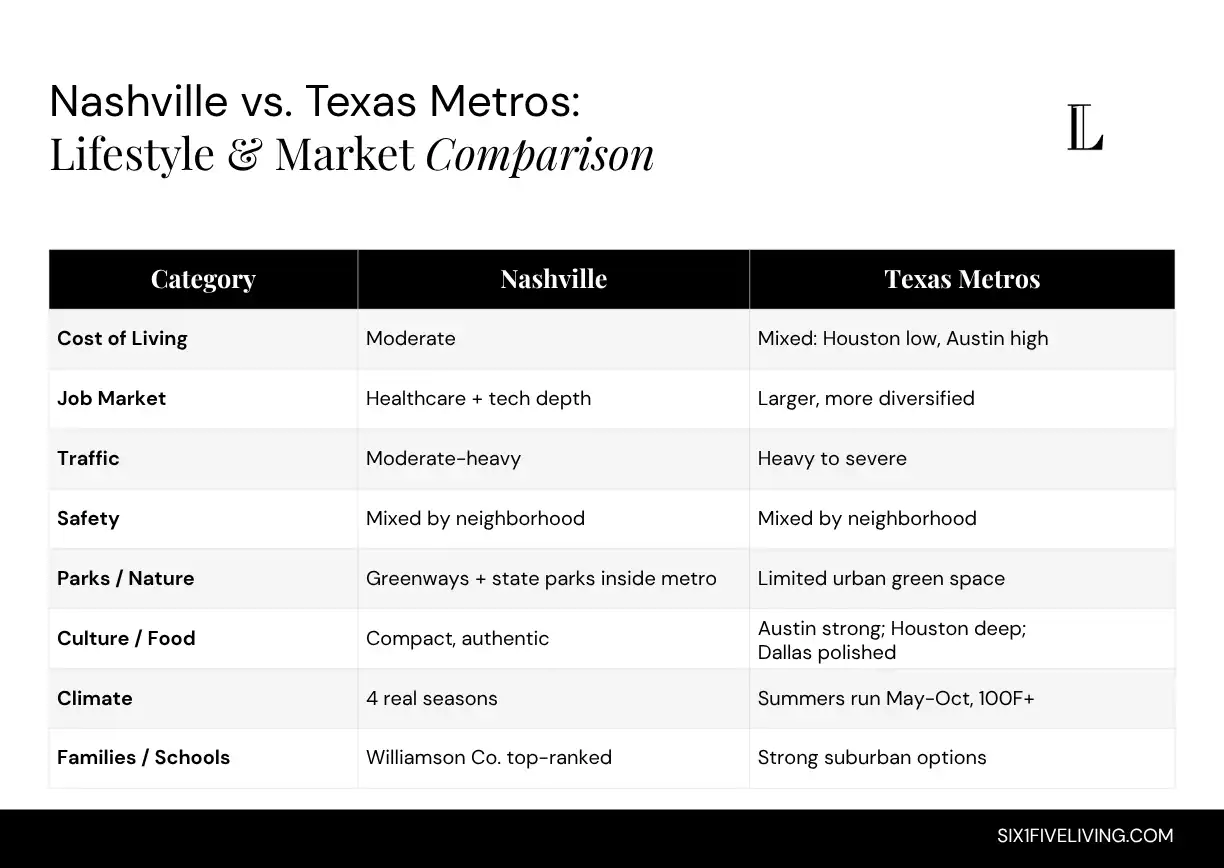
Cost of Living
Both Tennessee and Texas have no state income tax on wages. That puts them on equal footing at the headline level. The real difference shows up in property taxes.
Texas funds local government through property levies. Effective rates in Austin, Houston, and Dallas typically run 1.7% to 2.2% of assessed value, according to the Tax Foundation. Tennessee’s effective rates are among the lowest in the Southeast, often below 0.7%. On a $450,000 home, that gap is $5,000 to $7,000 per year. Every year.
On home prices, Nashville’s metro median sat at approximately $450,000 as of early 2025, according to RealTracs MLS data. Austin hovers around $525,000 after a pandemic run-up that has not corrected. Houston is the outlier at roughly $310,000. Dallas tracks close to Nashville at around $400,000. Nashville is cheaper than Austin in total housing costs. Houston beats Nashville on sticker price, but the property tax gap quickly closes much of that advantage.
Job Market
Dallas-Fort Worth has the largest economy of the four. Finance, technology, logistics, healthcare, telecommunications: the depth across industries is real. Houston anchors global energy. Austin is the dominant Texas tech hub, with Apple, Tesla, and Google all running major campuses there.
Nashville’s strongest sector is healthcare and health tech. More than 500 healthcare companies are headquartered here, according to the Nashville Health Care Council. Oracle relocated its global headquarters to Nashville in 2021. For professionals in healthcare, health technology, or adjacent services, Nashville has a higher density of opportunities than any other Texas metro. For everyone else, Dallas has the edge on scale.
Traffic: Nashville Is Not Perfect, But Texas Is Worse
Nashville has a traffic problem. That is true. Interstates 65 and 24 back up badly during peak hours, and the public transit system is too limited to absorb it. Say that clearly and move on.
Houston and Dallas are consistently ranked among the worst traffic cities in the country. Commutes of 45 to 90 minutes are normal for a significant share of residents. Austin’s infrastructure has not kept pace with its growth rate. People who move from any of those cities to Nashville find it noticeably more manageable. The metro’s smaller footprint means more of daily life is accessible within a reasonable drive. Learning the surface street network rather than defaulting to the interstates is how Nashville commuters handle it. That is a lesson most people figure out in the first month.
Parks, Nature, and Climate: Nashville Wins This Category Clearly
Percy Warner Park covers more than 3,000 acres inside the metro. Radnor Lake is a state natural area 10 miles from downtown. The Cumberland River Greenway runs through the city. Multiple state parks are within 90 minutes. The Smoky Mountains are three hours east. The landscape is forested and rolling. None of the Texas metros can offer anything close to that inside their footprints.
Climate is a bigger factor than most comparison articles acknowledge. Texas summers regularly hit 100 degrees and run from May through October. That is five months where outdoor activity is uncomfortable or impossible during daylight hours in Houston and Dallas. Austin has some relief from the heat compared to Houston, but not much. Nashville has four real seasons. Fall and spring here are genuinely good. That is not a minor lifestyle detail for people who spend time outside.
| People who move from Houston to Nashville and prefer it consistently cite two things: the traffic and the seasons. Both are quality-of-life factors that do not show up in cost-of-living calculators. |
Safety: Compare Neighborhoods, Not Cities
City-level crime statistics are misleading in all four markets. Nashville, Houston, Dallas, and Austin all show significant variation across neighborhoods. The suburban communities that most relocating families target, Williamson County near Nashville, The Woodlands or Sugar Land near Houston, Southlake near Dallas, and Round Rock near Austin, have broadly comparable and low crime profiles. The right comparison is suburb-to-suburb. Anyone making a safety judgment based on city-wide averages is comparing the wrong things.
Culture and Food: Each City Has Its Own Strengths
Nashville and Austin are more similar than people expect. Both are built around live music. Both have transplant-heavy populations that create an open, easy-to-enter social culture. Both have food scenes that have matured well beyond the stereotypes. Austin is larger and has more of everything. Nashville’s compactness means people actually engage with what it offers rather than driving 40 minutes to get there.
Houston is the most underrated of the four. It is the most ethnically diverse large city in the United States, and that diversity produces a food scene with genuine depth across cuisines and price points that Dallas and Austin cannot match. Dallas is polished and professionally oriented, with a strong arts infrastructure anchored by Deep Ellum and the Dallas Arts District.
Families and Schools
All four metros have strong suburban family options. The difference is driving distance. Williamson County Schools, which serves Franklin and Brentwood, is competitive with the best suburban districts in Texas. Those communities sit 20 to 25 minutes from downtown Nashville. Southlake near Dallas, Round Rock near Austin, and The Woodlands near Houston typically sit 40 or more minutes from their respective city centers. That gap shapes daily life: how long the commute takes, whether kids can access city amenities, and how often families actually use the urban core they moved near.
For young couples without kids, Nashville’s urban neighborhoods are denser and more walkable than most Texas alternatives outside of Austin’s central core. The relocation conversation is worth having early if you are coming from a Texas metro, have a specific timeline, and need to get the school district decision right before you start touring homes.
The Bottom Line
Dallas-Fort Worth wins on a career scale and industry diversity. Houston wins on housing affordability. Austin fits tech careers at a specific lifestyle orientation, if the cost and traffic are acceptable trade-offs for what the city offers.
Nashville wins on traffic, climate, green space, and total housing costs compared to Austin. It wins on healthcare career density against all three. The buyers who move here from Texas and prefer it are consistently the ones who hit the ceiling on what Dallas or Austin could offer them relative to what those cities demanded in commute time, heat, and carrying costs. What the Nashville market currently looks like puts that comparison on a specific price-point footing worth seeing.
Comparing Nashville to a Texas metro is easier with current numbers in front of you and someone who knows both sides of the move. Start the relocation conversation to talk through timeline, schools, and neighborhoods, or reach out directly and we’ll walk you through what today’s market means for your specific situation.
Frequently Asked Questions About Nashville vs. Austin, Houston, and Dallas
Is Nashville cheaper than Austin?
Yes, on the total cost of living. Nashville’s median home price is lower than Austin’s, and Tennessee’s effective property tax rates are well below Texas equivalents, which typically run 1.7% to 2.2% of assessed value. Both states have no income tax on wages. The property tax gap alone adds $5,000 to $7,000 per year to the cost of a comparable home in Texas compared with Tennessee.
How does Nashville’s job market compare to Dallas or Austin?
Dallas-Fort Worth has the largest and most diversified economy of the four cities. Austin leads in tech. Nashville’s strongest sector is healthcare and health tech, where more than 500 companies are headquartered locally. For professionals in those fields, Nashville’s depth of opportunity exceeds any Texas metro. For broad industry career flexibility, Dallas has the scale advantage.
Which is better for families, Nashville or the Texas suburbs?
Williamson County Schools, serving Franklin and Brentwood, is competitive with the top suburban districts in Texas. The key difference is proximity: those communities sit 20 to 25 minutes from downtown Nashville. The top Texas suburban school districts typically sit 40 or more minutes from their city centers. That commute gap is a daily quality-of-life factor, not just a map measurement.
Social Cookies
Social Cookies are used to enable you to share pages and content you find interesting throughout the website through third-party social networking or other websites (including, potentially for advertising purposes related to social networking).